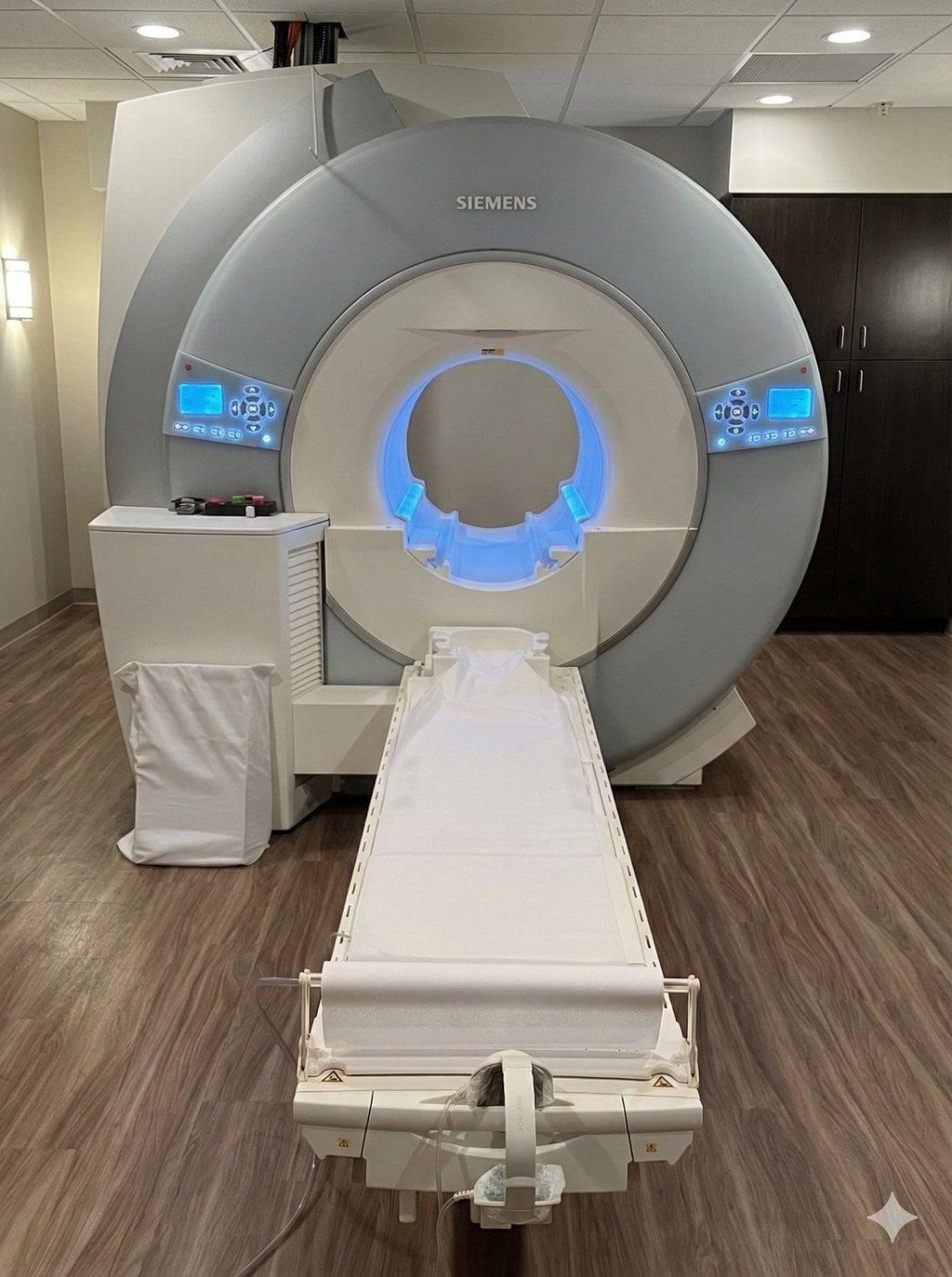
DaTscan is a type of nuclear medicine imaging study that uses a small amount of a radioactive tracer to visualize the brain’s dopamine system. Specifically, it targets the dopamine transporter (DAT), a protein on dopamine-producing nerve terminals in a brain region called the striatum. Using SPECT (Single Photon Emission Computed Tomography) imaging, DaTscan allows neurologists to examine the integrity of the dopaminergic pathways that control movement.
Unlike a standard MRI or CT scan, which show brain structure, DaTscan reveals brain function, specifically, whether the dopamine-producing neurons that are critical to movement are intact or depleted.
Why Is DaTscan Important in Parkinson’s Disease?
Parkinson’s disease develops through the gradual loss of dopamine-producing nerve cells in the substantia nigra, a region of the brain that plays a central role in coordinating smooth, controlled movement. As dopamine levels fall, patients develop the characteristic features of parkinsonism: tremor at rest, muscle stiffness (rigidity), slowness of movement (bradykinesia), and postural instability.
DaTscan supports the diagnostic process in several key ways:
- Detecting reduced dopamine transporter activity consistent with Parkinson’s disease and related neurodegenerative parkinsonian syndromes
- Supporting diagnosis during early or diagnostically uncertain presentations, particularly valuable when symptoms are mild or atypical
- Distinguishing Parkinson’s disease from essential tremor, drug-induced parkinsonism, and functional movement disorders, conditions that may look similar clinically but do not involve dopaminergic neurodegeneration
What DaTscan Can and Cannot Do
It is important for patients and families to understand both the power and the limits of DaTscan as a diagnostic tool.
DaTscan can:
- Demonstrate whether dopamine transporter activity is reduced, supporting a diagnosis of neurodegenerative parkinsonism
- Help differentiate parkinsonian conditions from non-parkinsonian tremors or movement disorders
- Provide an objective imaging correlate to support clinical findings
DaTscan cannot:
- Identify which specific parkinsonian disorder is present, it cannot distinguish between Parkinson’s disease, Progressive Supranuclear Palsy (PSP), Multiple System Atrophy (MSA), or Dementia with Lewy Bodies
- Replace a comprehensive clinical neurological evaluation, which remains the foundation of Parkinson’s diagnosis
- Predict the rate of disease progression
What to Expect During the Test
DaTscan is a straightforward, outpatient procedure. The process involves:
- An intravenous injection of the radioactive tracer (ioflupane I-123)
- A waiting period of several hours to allow the tracer to bind in the brain
- A 30 to 45 minute SPECT scan, during which you lie still while the scanner captures detailed images of your brain’s dopamine system
The radiation exposure from DaTscan is comparable to other standard diagnostic imaging studies and is considered safe. Most patients return home the same day with no restrictions on activities.
How Charis Neurology Uses DaTscan
At Charis Neurology, we recommend DaTscan when the clinical diagnosis of parkinsonism is uncertain, or when distinguishing between different movement disorders will meaningfully change the treatment approach. Dr. Makar interprets DaTscan results alongside the full clinical picture, including neurological examination, symptom history, medication response, and other imaging findings, because no single test tells the complete story.
Our goal is always to give patients and families the clearest possible understanding of what is happening in the brain, so that treatment decisions are grounded in accurate, individualized information.
The Bottom Line
Although Parkinson’s disease remains fundamentally a clinical diagnosis based on careful neurological evaluation, DaTscan serves as a powerful supportive tool. When the clinical picture is unclear, DaTscan can provide the diagnostic clarity that patients and families need to move forward with confidence.
If you or a loved one in Lake Mary, Sanford, or the greater Orlando area are experiencing tremor, stiffness, or changes in movement, we encourage you to schedule a consultation with the movement disorder specialists at Charis Neurology.